


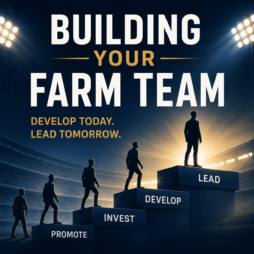
We have covered a lot of ground over the past eight weeks.
We have talked about why your best managers are leaving, what a farm team really means in business, the hidden cost of promoting someone and walking away, why online courses alone are not developing your leaders, the difference between surviving and leading, the three elements most programs skip, and the conversation your managers need to have with you right now.
Today I want to bring it all together with the question every senior executive eventually asks, “What is the return on investment?”
It is a fair question. A responsible question. And I want to answer it as directly and concretely as I can.
The Costs You Are Already Paying
Before we talk about the return, let us be honest about the costs that are already present whether you invest in development or not.
The cost of manager turnover (recruiting, onboarding, lost productivity, team instability) runs between fifty and two hundred percent of annual salary per departure. In a company with ten to twenty managers, even one or two departures per year represents a significant financial impact.
The cost of an underperforming manager is harder to calculate but arguably larger. A manager who is surviving rather than leading is not just underperforming themselves, they are creating conditions for their entire team to underperform. The cost of reduced engagement, slower execution, higher turnover within the team, and missed opportunities compound quietly over time and rarely get attributed to their actual source.
The cost of a disengaged team is well documented. Gallup research consistently shows that teams with low engagement produce meaningfully lower output, experience higher turnover, and generate significantly lower profitability than engaged teams. And the single greatest driver of team engagement is the quality of their direct manager.
These costs are not hypothetical. They are present in your organization right now to varying degrees. The question is not whether you are paying them. The question is whether you are doing something about them.
The Return Side of the Equation
Now let us talk about what changes when you invest in developing your managers well.
Retention improves, at the manager level and within their teams. Managers who feel developed and valued stay longer. And managers who lead well retain their teams more effectively. The compounding effect of reduced turnover alone often justifies the development investment within the first year.
Execution accelerates. A manager who has made the shift from surviving to leading is operating with clarity, confidence, and intentionality. Their team is aligned, accountable, and moving in the same direction. The output difference between a team led well and a team led poorly is not marginal. It is material.
Culture strengthens. The managers in the middle of your organization are the primary carriers of your culture. They translate values into daily behavior, set the tone for how people treat each other, and model what the organization actually rewards. Investing in their development is investing in the culture you want to build, not just the one you talk about.
Leadership pipeline deepens. Every mid-manager you develop well is a potential future senior leader. Organizations that build intentional farm teams are not scrambling to fill senior roles from outside. Instead, they are promoting from within with confidence because they have built the pipeline. That is a competitive advantage that takes years to build and is very difficult for competitors to replicate quickly.
What the Math Actually Looks Like
Let me make this as concrete as possible.
The Mid-Manager Program is a six-month investment. When you compare that investment to the cost of losing and replacing even one manager, let alone the downstream costs of an underdeveloped management layer, the math is not close.
But the more important calculation is not the cost comparison. It is the value creation.
A manager who enters the program surviving and exits leading is not just less likely to leave. They are actively creating more value, for their team, for the organization, and for the future leadership pipeline you are building. That value does not disappear at the end of the six months. It compounds every quarter, every year, for as long as that person leads within your organization.
That is the return that does not fit neatly into a spreadsheet but that every experienced executive understands intuitively. Developed people create developed organizations. And developed organizations outperform underdeveloped ones, in results, in culture, and in their ability to attract and retain the talent they need to grow.
The Executives Who Get This Right
In my experience, the executives who invest most intentionally in their mid-managers share a common characteristic.
They think in years, not quarters, when it comes to their people.
They understand that the managers they develop today are the senior leaders who will carry the organization forward in three, five, and ten years. They see that investment not as an expense but as infrastructure and as essential to sustainable growth as any technology, process, or market strategy.
They are also the executives whose organizations consistently outperform in retention, culture, and execution. Not coincidentally.
Building your farm team is not a program. It is a philosophy. It’s a long-term commitment to treating the development of your people as one of the most important strategic investments you make.
The organizations that embrace that philosophy will build something their competitors struggle to replicate. Because you can copy a product, a process, or a market strategy. You cannot easily copy a culture of developed, confident, capable leaders who are deeply committed to the organization that invested in them.
Where to Go From Here
If this series has resonated with you, if you have recognized your organization in some of what I have described, I would love to have a direct conversation.
The Mid-Manager Program is designed for exactly the kind of organization you lead. Growing, ambitious, and ready to make the investment in the middle that will define the next chapter of your company’s growth.
Reach out directly or visit our website to learn more. I look forward to the conversation.
Building your farm team is some of the most important work you will do as a leader. I am glad to be a resource in that work.








































11710 Plaza America Drive, Suite 2000 Reston, VA 20190
703.278.CORE (2673)

Leave a Reply