


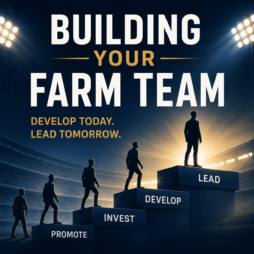
If you follow baseball, you know what a farm team is.
It is the system of minor league teams that the major league organization intentionally builds, funds, and develops. The players there are not ready for the big stage yet, but the organization believes in their potential and invests in developing them so that when the moment comes, they are ready.
The best franchises in baseball are not just winning today. They are building for the next five years simultaneously. They know exactly who is coming up through the system, what they need to develop, and when they will be ready.
Now let me ask you something.
Does your organization operate that way?
The Business Translation
In your company, your farm team is your mid-level managers.
They are not your senior leadership yet. But they are the people who will be. They are the ones carrying the weight of execution today while simultaneously developing into the leaders your company will need tomorrow.
The question is not whether you have people in that pipeline. You do. The question is whether you are being intentional about developing them or simply hoping they figure it out on their own.
Hope is not a development strategy.
The most forward-thinking executives I work with have shifted the way they think about this layer of their organization. They have stopped seeing mid-managers as a cost center and started seeing them as a strategic asset. They invest in them the way a great franchise invests in its farm system – with structure, intentionality, and a long view.
And the results show up everywhere. Retention improves. Culture strengthens. Execution accelerates. And when senior roles open up, there are capable, prepared people ready to step into them.
What Most Companies Do Instead
Most companies do the opposite.
They promote their best performers into management, hand them a title, and assume the rest will work itself out. When those managers struggle, the organization either tolerates underperformance or replaces them and the cycle starts over.
Others invest in development, but not in a way that actually works. They send managers to a one-day workshop. They purchase access to an online course library that nobody finishes. They hand someone a book and call it coaching.
These are not farm team investments. These are checkbox solutions. And they produce checkbox results.
What separates a real farm team development strategy from a checkbox solution comes down to three things: structure, sustainability, and human connection.
Structure means your managers are learning within a defined, intentional curriculum, not piecing together random information on their own time.
Sustainability means the development happens over months, not hours. Real behavior change takes time. You cannot develop a leader in a day.
Human connection means there is coaching, accountability, and community built into the experience. Someone is in their corner. Someone is checking in. Someone is challenging them to apply what they are learning in real time.
The Question Worth Asking
The best baseball franchises do not build farm systems because it is easy. They do it because they understand that sustainable winning requires a pipeline.
The same is true in business.
If your company disappeared tomorrow and took its mid-managers with it, how long would it take you to rebuild that layer of leadership from scratch? How much institutional knowledge, relationship capital, and execution capacity would walk out the door?
That question should inform how seriously you take their development.
Building your farm team is not a nice-to-have. For any company serious about sustainable growth, it is one of the most important investments you can make.
Next week, we are going to talk about what it actually costs when you promote someone and walk away and why that cost is almost always invisible until it is too late.








































11710 Plaza America Drive, Suite 2000 Reston, VA 20190
703.278.CORE (2673)

Leave a Reply